The November 2025 Saudi Birding Custom Tour
Updated: Aug 11
Saudi bird tour Oman bird tour Middle East Bird Tour Birding Tour Birdwatching Tour Yemen Bird tour
Tour Dates: November 24 - 29, 2025
Duration: 6 days
Species Recorded: 158
Participants: Judith Allanson, Richard and Sharon Collins, Susan Lashko, Garrett and Susan Milks
Leader: Gregory Askew
Co-guide: Ibrahim Al Shwamin
Avian Highlights:
Arabian Partridge
Philby's Partridge
Rameron Pigeon
Nubian Nightjar
Montane Nightjar
Crab-Plover
White-eyed Gull
Gabar Goshawk
Dark Chanting-Goshawk
Arabian Scops-Owl
Little Owl
Red Sea Collared Kingfisher
Arabian Woodpecker
Black-crowned Tchagra (Arabian)
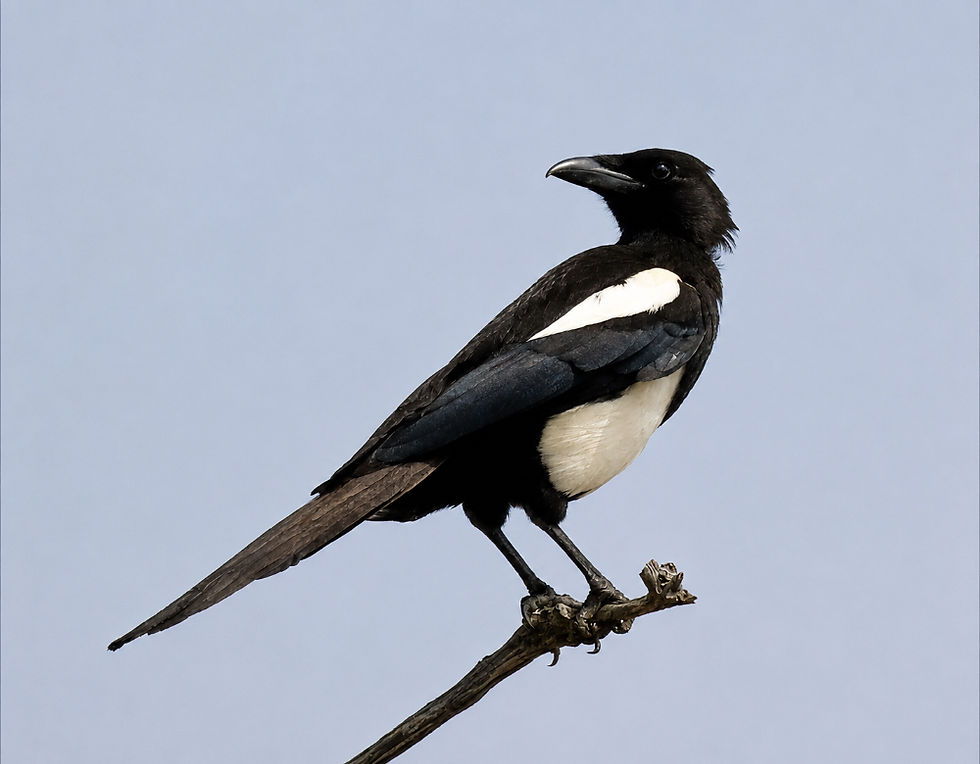
Asir Magpie
Arabian Lark
Common Reed Warbler (Mangrove)
Yemen Warbler
Arabian Warbler
Yemen Thrush
African Stonechat
Buff-breasted Wheatear
Arabian Wheatear
Nile Valley Sunbird
Arabian Sunbird
Arabian Waxbill
Arabian Golden Sparrow
Olive-rumped Serin
Yemen Serin
Yemen Linnet
Other Wildlife Highlights:
Hamadryas Baboon
Yemen Rock Agama
Anderson's Rock Agama
Besides our twice annual Arabian endemics tours, Saudi Birding offers custom bird tours throughout the year. These are geared towards finding our guests’ particular target species while accommodating other interests and personal preferences. As a guide, I’m always excited to lead a custom tour as they often take us a little more off the beaten path.
So it was November 2025. Rick, Sharon, and their friends had just come off of a two-week tour of the UAE and Oman and wanted to cap off their Middle Eastern birding adventure with six days of targeted birding in Saudi. The aim, of course, was to clean up on the Arabian endemics as well as try and pick up as many near-endemics, regional specialties, and harder-to-find wintering species as possible.
Six days would be just enough time to tick the endemics and near-endemics. However, their traveler’s insurance added a slight wrinkle to an otherwise straightforward itinerary—we couldn’t travel to Jazan. This is where I always take guests for three of the species on their target lists—Nubian Nightjar, White-eyed Gull, and Arabian Golden Sparrow. No worries though. I planned a route that, once we reached the southwest, would start and finish in Al Bahah, skirting Jazan altogether. As for those targets, I pinpointed a series of stops in Google Maps where I thought we had a good chance of seeing them and with two days at the end of the tour dedicated to finding them I figured we’d have plenty of time as well.
By the end of day six, we had found all but one of the group’s prime targets and managed to get much better views of a few species they'd already seen in Oman. Rufous-capped Lark, unfortunately, proved the bogey bird this time around. While November can be a phenomenal time for desert birding, the cooler, drier conditions in the southwest highlands often mean certain species, particularly Rufous-capped Lark and Arabian Waxbill, become harder to find.
That one disappointment notwithstanding, the November 2025 custom tour was full of great birding with many standout sightings.
Saudi Birding Custom Tour Itinerary
Day 1—Riyadh
Like most Saudi Birding tours, we started with a morning north of Riyadh searching for Arabian Lark near Rawdat Nourah. Unlike most tours, it took us virtually the whole morning to find one!
Nevertheless, we had productive birding from almost the very first moment we set out across the sand-gravel plain. Within the first hour or so we saw Chestnut-bellied Sandgrouse, Brown-necked Raven, Greater Hoopoe-Lark, a few dozen Bar-tailed Lark (with many more to come), Black-crowned Sparrow-Lark, Crested Lark, Asian Desert Warbler, Isabelline Wheatear, and Desert Wheatear.
Time was passing though as we weaved our way through patches of scrubby desert where I’d seen Arabian Lark in the past. I had but one spot left before we’d have to expand our search elsewhere.
As we pulled up to the area, we watched as nearly two dozen larks lifted off in front of us, settling back down a short ways off. I began scanning birds on the ground, adding more Bar-tailed Larks to our already impressive haul, when a slightly larger and brighter lark caught my eye. We had finally found Arabian Lark, a species almost exclusively seen in Saudi in recent years.
By and by everyone got scope views of not just one but two of these subtly striking birds. Eventually we even had one in song flight just overhead, showing the nearly all black rectrices that help separate this species from Bar-tailed and Desert Larks.
While still thrilling from our encounter with Arabian Lark, we soon also got on a couple Temminck’s Larks as well, another lifer for a few in the group.
Given the time it took us to find Arabian Lark, we were forced to scrap our planned stop for Pharaoh Eagle-Owl and headed back towards Riyadh, stopping for a hearty lunch at an Afghan Restaurant on the way.
Of the nine Saudi Birding tours since March 2022, only one failed to produce Arabian Lark. That’s a solid record for a bird that took me over three years to finally see while living in the Kingdom.

Day 2—Al Bahah
The next morning found us ticking our first Arabian endemics, like Yemen Thrush, Arabian Serin, and Yemen Linnet, in wooded slopes and wadis near Al Bahah in Saudi’s southwest.
We started a little later than expected because a certain someone—knackered from his flight from Texas—managed to sleep through his alarm! No harm nor foul, though, as our first stop was still in shadow when we finally got there. Our key target of the morning was Arabian Grosbeak, which we’ve seen on a few occasions from a stakeout along the road into the Khairah Forest Park. Having found it quite quiet there, though, we headed to the spot we had seen them back in April 2025, a public park where we’d have breakfast.
No sooner had we arrived than I began hearing grosbeak song. Breakfast would have to wait—we had grosbeaks to find! Sure enough, I briefly got on the songster—a lovely male—perched near the top of a bare juniper. Unfortunately, he flew off before I could get the group on him. Then began the hunt to relocate him, ping-ponging to and fro as I picked up faint singing at different spots around us. At one point a male was singing from inside a juniper crown, exactly where I couldn’t determine, so we all stood waiting and watching for a moment before he briefly flew into view and then promptly disappeared behind some trees. While the group had all seen the grosbeak in flight—they’d seen it in Oman the week prior in fact—better views were desired, so we kept up the search.
A short walk down one of the paths through the park produced our first views of Graceful Prinia (Prinia gracilis yemenensis), the same subspecies we had all seen in the Dhofar Region of Southern Oman during our respective tours. White-spectacled Bulbuls, Brown Woodland-Warblers, and Abyssinian White-eyes were calling from the juniper stands all around us.
Soon we had our first Scrub Warblers (Scotocerca inquieta buryi) of the tour as well as the surprise appearance of a Bluethroat in the brush near the edge of a stream. A troupe of Arabian Babblers flew from tree to tree after we disturbed their morning forays.
It was on our way back down the path that the quiet singing of a male grosbeak caught my ear, in quite close this time, and I looked up to my left to find not one but four Arabian Grosbeaks feeding near the top of a juniper, not more than five meters from us. Boom! Better views acquired!
A lone male, perhaps the same one we’d heard earlier, kept singing for the remainder of the time we stayed at the park, offering me a chance to capture some recordings. In the cut below, you can hear him issue the species’ telltale catbird-like mew call interspersed throughout a series of short, whistled phrases and churring, almost robotic notes.
By late afternoon we had arrived to Tanomah and headed straight for Mehfar Tourist Park. As it was nearing sunset, we heard an Arabian Partridge calling from around the edge of the escarpment, now warmly lit by the setting sun. After some scanning, the group was enjoying scoped views of a small covey working its way up the mountain.
This was the only Arabian endemic both Oman tours—the one I had led and the one my current guests had just completed—had stunningly failed to see in Southern Oman. Here on day two of our Saudi extension we had just had our first of four encounters.
Species we hadn’t missed in Oman were the two endemic owls, which, thankfully, made for shorter days out. We stuck around Al Mehfar Park, however, to try our luck with Desert Owl. Owing to a school holiday though, there were picnickers in the spot where I had hoped to try for the owl. We made a vain attempt at a different location but then shifted our attention to one species not found in Oman—Montane Nightjar. In a knot of trees on the back side of the park we had a male singing, passing briefly overhead a few times in response to playback.
Day 3—Tanomah
Early the next morning we added Philby’s Partridge right inside the village we drive through to our usual stakeout. A covey was hanging out among some of the derelict buildings and flushed as we rounded a corner in the center of the village. We carried on to the stakeout, however, hoping to get everyone better views.
Here we had our first Arabian Green Bee-eater of the tour—a different subspecies (Merops cyanophrys cyanophrys), one of two found on the Arabian Peninsula, than the one seen in Oman (Merops cyanophrys muscatensis).
Then, after some time waiting, the Philby’s Partridge made an appearance on the opposite side of the wadi, eventually moving out onto a sunny patch in the bottom of the wadi to forage.
With that, the other endemic partridge was in the bag, it was time to look for the one species found nowhere else in Arabia—in the world for that matter—than in Saudi Arabia.
And it was at another village a short drive away that we found our first Asir Magpies visiting a feeding site in the courtyard of one of the houses. They were carrying away what appeared to be pieces of bread. Given their attraction to the spot, we waited outside the walls of the house and eventually had great views on their return visit.
We had five endemic targets left to find and I knew just the place to potentially add at least three in one stop. Hiking back into a tall cluster of junipers at Al Sharaf Park, we soon had our first and only Yemen Warbler of the tour. A calling flock of Yemen Serin passed overhead and settled on a sheer rock wall that towered above the woods. Later, after being treated to views of a male Arabian Woodpecker, we found a large flock of around 30 serin foraging on the ground just four meters ahead of us. Much better viewing all around than either tour got in Southern Oman, where views were distant, brief, and involved only one or two birds.
Later in the afternoon, we stopped at Wadi Reema on our way to Abha. The goal was to try and add Rufous-capped Lark and Buff-breasted Wheatear and thereby offset the need to visit Habala the next day, especially since we’d already seen Yemen Serin. While we did find Buff-breasted Wheatear, we unfortunately couldn’t find any Rufous-capped, making a visit to Habala critical.
Our final stop of the day was at Soudah Creek. I was hoping we’d finally get the waxbill, but as I found in November 2024 the area was quite dry and not nearly as birdy as it usually is. Most of the locals were present, including African Stonechat. No waxbills, however. I had also hoped to find the resident pair of Arabian Scops-Owls at their roost but the terrace here had recently been ploughed and there were deep furrows all around the roost tree. Best bird of the stop, though, had to have been the group of African Gray Hornbill that flew in from further up the wadi. This was the first time I had ever seen them at that spot, let alone at that elevation—the species most commonly found below 1500 meters and here we were at 2400 meters!
Day 4—Abha
Having already seen Arabian Partridge three times up to that point meant we didn’t need to get to Raidah Preserve early. After securing access with one of the rangers, we began our descent a little past seven in the morning. Besides potentially stumbling on waxbills here, we had only two other targets for this stop, so I was determined to make quicker time here to allow more time later in the day for Rufous-capped. The first we found exactly where I expected—a small group of Rameron Pigeon perched alongside the road near the mosque. The second, Black-crowned Tchagra, would prove a bit more involved this time around because just as the other vehicle was pulling up to my first tchagra stop it hit a large rock in the road, making a two-inch gash near the sidewall of the tire. It was totally flat in less than a minute.
This meant Ibrahim and I would need to deal with the flat as our guests tried for the tchagra on their own. I explained the strategy I use to draw them in and where along the road to try and then set them off on the hunt.

Changing the tire was a bit of a process, including partially deflating and re-inflating the spare, which was full sized, but this wasn’t my first rodeo in Saudi. Past punctures had prompted me to buy a portable compressor, which I have brought on my tours for over a year now. In that time it has helped us out of a few jams.
Once Ibrahim and I were back on the road, we picked up our guests and then drove to the village at the end of the road. As expected, we added Blackstart and Arabian Sunbird to the trip list just before reaching the main mosque in the village.
After a quick field breakfast, we took a walk down into the wadi bottom. A familiar scolding call alerted me to the presence of a Black-crowned Tchagra, which everyone got amazing views of as it scolded us from atop of dense candelabra-shaped Euphorbia ammak in lovely morning light.
A little further on we found our first and only White-browed Coucals of the tour. They’re a regular here.
Our final endemic target—Arabian Waxbill—had eluded us up to that point. The very dry conditions we had encountered up to that point suggested we could potentially dip on them at our upcoming stops, especially since we’d be leaving the highlands that afternoon. Not entering Jazan also meant not birding Al Sadd Lake, the lowlands spot I typically target this otherwise common species during the cooler months. This meant I’d have to add a detour to our already challenging schedule for the day, more challenging still owing to the tire situation, which now required getting a replacement for the other vehicle before we could set off.
Once that was done, we headed to Atwad Dam on our way to Habala, where, as hoped, we connected with Arabian Waxbill soon after arriving. Then we made a bee-line to Habala with the intent of using much of the remaining daylight to search for Rufous-capped Lark. Yet, despite making a few circuits around the area, including driving out across the plateau where I’ve seen them multiple times, we failed to find any. Wheatears were fairly well represented though with four species including Arabian and Buff-breasted, and we saw our second of only two Long-billed Pipits (Anthus similis arabicus) for the tour.
We left ourselves just enough light to reach Al Darb, our first lowlands stop, just after dark. After a full day of birding and a long—at times hairy—drive down the mountain, the group was fairly maxed out but we had one target left to find—Nubian Nightjar. I had a solo client in June who also wanted to see this lovely nightjar but didn’t have the time to visit Jazan, where we usually go to see them, so I pinpointed some promising habitat along the route for he and Ibrahim, his guide for that trip, to try. Sure enough it proved a good spot for nightjars.
Shortly after we arrived to the site I began hearing nightjars out around the shallow acacia-lined wadi. We wandered out in it for a time, trying to get closer to a nightjar that had briefly flown past us, only to return to the road empty-handed. Meanwhile I sent Ibrahim to check back up the road and he soon reported having seen one. By the time we packed it in for the hotel, we had found two Nubian Nightjars on the ground fairly close to the road.
Day 5—Al Darb to Al Qunfundhah
The next day was to be a series of stops on our way up the coast, looking to pick up targets along the way. Several of those stops were meant to allow for multiple chances of seeing Arabian Golden Sparrow should we miss them at earlier stops. Alas my planned itinerary tightened up significantly when we found small flocks of Arabian Golden Sparrow coming in to drink at a leaking water tower in a village near Al Darb.
The village that morning was quite active with birds. A few raptors hunting around the area turned out to be Eurasian Sparrowhawks and one striking Gabar Goshawk. Nile Valley Sunbird and African Silverbill were new additions to the trip list. We were also treated to a surprise visit by a group of eight Rosy Starlings mixing it up with a larger flock of Common Myna.
From there we called in at Al Haridhah, first finding White-eyed Gull among others gulls along the town’s corniche road. We then stopped at the mangroves a little further north, ticking Crab-Plover on the way in, followed by Red Sea Collared Kingfisher (Todiramphus chloris abyssinicus), and a surprise Egyptian Nightjar on the way out.
The seabird roost just past Al Birk wasn’t as productive as I was hoping, but we did add some coastal species not yet seen on the trip, including our first and only Little Heron (Butorides atricapilla), formerly called Striated Heron before being split from that now exclusively South American species.
Our next big stop was at the Wadi Haly area with good birding on our way in as well as at the series of pools near the dam. Along the access road we had several nice looking Abyssinian Rollers and awesome views of an immature Dark Chanting-Goshawk perched on a pylon along the roadside. While we didn’t pick up any stray targets along the way, the pools were full of birds and made for a very interesting stop. There were perhaps the most ducks I’ve ever seen in one place anywhere in Saudi Arabia, including Eurasian Wigeon, Common Pochard, and Ferruginous Duck. Among the shorebirds present we had Pacific Golden Plover, Little Ringed Plover, and White-tailed Lapwing. Meanwhile, just overhead we picked up singles of Steppe Eagle and Booted Eagle.
We continued on our way to Al Qunfudhah, stopping just outside the city to marvel at a ginormous gathering of eagles just off the road. Hundreds of Steppe Eagles were perched on electrical pylons or soaring in the sky above with a few other species interspersed, including Greater Spotted Eagle and two hulking Imperial Eagles.
Day 6—Al Qunfundhah to Al Bahah
Our final morning in Saudi arrived. With nearly all of our targets in the bag, the plan was to make a stop at the Thee Ain Heritage Village before spending the rest of the time before our flight searching for Rufous-capped Lark near the airport.
The heritage village was quiet as expected, which made for a very casual tour of the site. I had seen a big flock of Arabian Waxbills here in February 2025. Thankfully I opted not to count on a repeat sighting here and took the group to Atwad Dam instead because this time around they weren’t anywhere to be seen. There were far fewer bats in the Doum Palms as well but we did manage to find a couple on our way out.
The best bird of the stop was Sharon’s Arabian Partridge on the backside of the village. That was our fourth and closest sighting of this endemic that evaded both groups entirely during our respective tours in Southern Oman.
After lunch in Al Bahah, we drove out to Al Aqiq, the town where the King Saud Airport is located, and visited a couple of spots I pinpointed as potentially good for Rufous-capped Lark. The best of the two by far was Al Aqiq Dam, where we found a wide-open swath of bare ground running down to the water’s edge. Here I was convinced we’d find the larks coming in to drink. However, after spending a couple hours in the area—still no luck. There were other good birds though, so we were glad for the distraction. There were many wheatears in the area, including three Persian Wheatears, a species not often seen in the west of the country. We also had our only Desert Larks of the tour here. In addition, we had a few Arabian Warblers and both Arabian and Palestine Sunbirds.
Despite dipping on Rufous-capped Lark, the tour delivered outstanding birding across a remarkable range of habitats, from central Arabian deserts to highland juniper forests and the Red Sea coast. Recording 158 species in just six days—including all but one of the group’s prime targets—was a testament to both careful planning and the flexibility required when birding in a dynamic landscape. With memorable encounters, several upgraded views, and a strong showing of Arabian endemics and regional specialties, the November 2025 custom tour was a fitting finale to an exceptional year in Middle Eastern birding.
Happy New Year, y'all! Good birding in 2026!
Interested in going birding with Saudi Birding? Click HERE to explore expert-guided bird tours in Saudi Arabia and elsewhere around the Middle East. We also offer custom tours, combining targeted birding with other experiences tailored to your personal interests and preferences.


Comments