Saudi Birding's Spring 2026 Arabian Endemics Tour
Updated: Aug 11
Tour Dates: March 26 - April 3, 2026
Duration: 9 days
Species Recorded: 183
Leader: Gregory Askew
Co-guide: James Conder
Avian Highlights: bird tour Saudi Arabia
Harlequin Quail
Arabian Partridge
Philby's Partridge
Rameron Pigeon
Nubian Nightjar
Red-knobbed Coot
Montane Nightjar
Crab-Plover
White-eyed Gull
White-cheeked Tern
Lesser Flamingo
Red-billed Tropicbird
Abdim's Stork
Goliath Heron
Arabian Scops-Owl
Arabian Eagle-Owl
Desert Owl
Arabian Green Bee-eater
Arabian Woodpecker
Sooty Falcon
Black-crowned Tchagra (Arabian)
Asir Magpie
Rufous-capped Lark
Arabian Lark
Common Reed Warbler (Mangrove)
Yemen Warbler
Arabian Warbler
Arabian Babbler
Violet-backed Starling
Tristram's Starling
Yemen Thrush
African Stonechat
Buff-breasted Wheatear
Arabian Wheatear
Nile Valley Sunbird
Shining Sunbird (Arabian)
Arabian Waxbill
Arabian Golden Sparrow
Arabian Grosbeak
Olive-rumped Serin
Yemen Serin
Yemen Linnet
Other Wildlife Highlights: bird tour Saudi Arabia
Arabian Wolf
Arabian Gazelle
Hamadryas Baboon
Blanford's Fox
Arabian Skittering Frog
Asir Garra
Hot on the heels of Saudi Birding's expedition to the Socotran Archipelago came our tenth Arabian Endemics tour, yet another successful quest to see all of the endemics, near-endemics, and regional specialities the Kingdom of Saudi Arabia has to offer. By the end of this nine-day adventure—with perhaps the most enthusiastic group I've had the pleasure of guiding—we had connected with all sixteen Arabian peninsula endemics, including Asir Magpie, Arabian Grosbeak, and Yemen Serin, every major near-endemic target, like Arabian Lark and Arabian Golden Sparrow, plus several memorable surprises along the way.
If you haven't yet, consider joining Saudi Birding on one of our future Arabian Endemics Tours and experience Arabian birding at its finest.
Kickoff!
Our first morning of birding began under unusually overcast skies north of Riyadh, where, thanks to longtime Saudi Birding friend Mischa Keijmel, we quickly connected with one of the tour’s toughest targets: Arabian Lark (Eremalauda eremodites). Mischa and Phil Hansbro, fresh off the Socotra tour as well, were birding Rawdat Nourah in hopes of finding the lark, Phil’s final Arabian target, when they came across a displaying male near the same area where we had seen one back in June 2024.
As soon as we got word, we hurried over and were greeted by the delightful sight of the lark hanging about virtually at their feet!
Thankfully, this time I actually had my recording gear ready and managed some of my best recordings yet of the male in song flight.
Having connected with Arabian Lark so early in the morning, we still had time to try for Pharaoh Eagle-Owl (Bubo ascalaphus desertorum) at a nearby sandstone wadi where Mischa had heard one while camping. Just before the skies opened up, we flushed an owl from a lone acacia in the wadi bottom and moments later everyone was enjoying scope views of this magnificent desert hunter.
Despite plenty of fine birding still to be had around the area, we took the increasingly steady rain as our cue to head back to Riyadh and prepare for the start of the southwest leg of the tour.

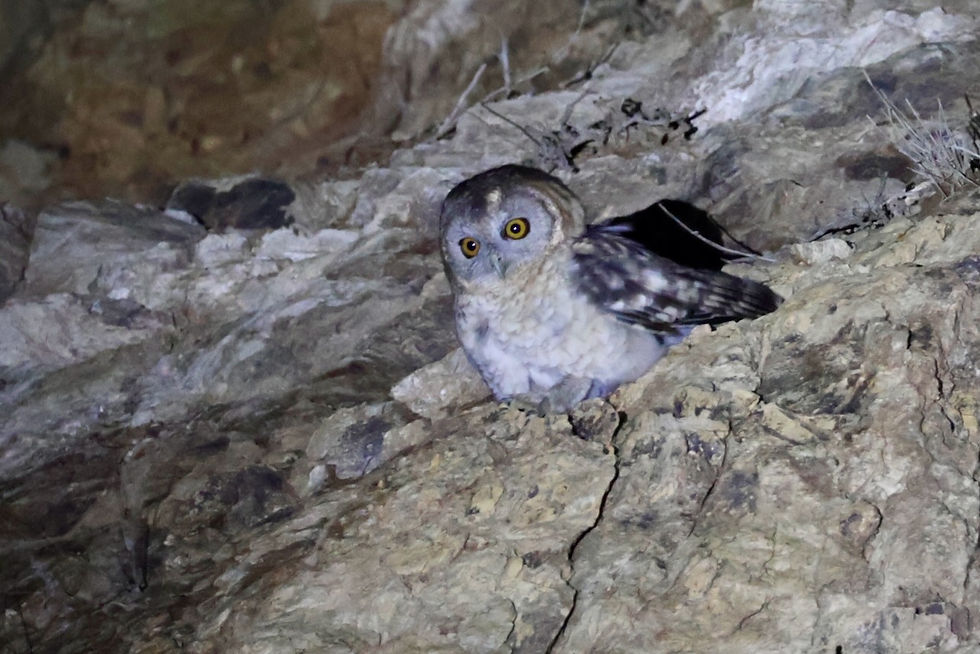
After landing in Al Bahah that evening, little did we know the day’s highlights were not yet over. Following a quick check-in at the hotel, we headed out to a spot along the Sarawat Escarpment to try for Desert Owl (Strix hadorami). Almost immediately, we heard one calling from nearby. A little coaxing later and—bam!—we were treated to a killer encounter with this charismatic owl.
Beyond the Arabian endemics themselves, both Pharaoh Eagle-Owl and Desert Owl ranked high on the group’s wishlist, and here we were with both already in the bag by the end of day one!
Peak Saudi Birding!
On our first full day in the highlands, the group struck gold early in the form of Arabian (Golden-winged) Grosbeak (Rhynchostruthus percivali). While this handsome endemic can sometimes take much of the morning to track down, on this occasion we had barely stepped out of the vehicles before I picked up the song of a male nearby. Within minutes everyone had enjoyed their first views of this often-retiring species. Further searching revealed a couple more birds in the vicinity feeding quietly on juniper berries deep within the crowns of the trees.

A wrong turn heading back to the hotel produced a surprise encounter with a covey of Philby's Partridge (Alectoris philbyi), our second encounter of the morning but providing our best views yet.
By the time we hit the road for our next destination, five of the Arabian endemics were already in the bag, among them Yemen Thrush (Turdus menachensis) and Yemen Linnet (Linaria yemenensis).
The cultural highlight of our first day was a visit to the Thee Ain Heritage Village, where the views rivaled the birding. The farms here can produce a nice mix of resident and migratory species, including several Afrotropical species. We found several African Gray Hornbill (Lophocerus nasutus), including two joining a feeding frenzy on a swarm of flying ants emerging from their underground colony. A lone African Shikra (Tachyspiza badia sphenura) gave phenomenal views as it stalked about the trees around us in search of easy prey.
The evening found us searching for owls and nightjars farther south. Since our targets had come a little too easily up to that point, the birding gods apparently decided it was time to put us through the ringer. We heard Arabian Eagle-Owl (Bubo milesi), Arabian Scops-Owl, and even Montane Nightjar, but for the longest time none would reveal exactly where they were hiding.
The eagle-owl was especially frustrating. It would call repeatedly from one area and then, a few minutes later, we'd hear it from somewhere completely different, sending us ping-ponging back and forth around the area for well over an hour. Then, as has happened before, we finally found it on our way out—a stately Arabian Eagle-Owl surveying its domain from atop a juniper tree.
That would prove to be the first of two encounters with this stunning endemic Bubo during the tour.
The next morning, our birding efforts were delayed by an early rain shower and then shrouded in cloudbank for much of the day. Undaunted by the chill in the air, we pressed on and were rewarded for our perseverance with three more endemic targets. During a hike into a lovely wooded wadi, ribbons of mists passing through the tops of the junipers lending an almost magical feel to the morning, we came across our first Asir Magpie (Pica asirensis), Buff-breasted Wheatear (Oenanthe bottae), and Yemen Warbler (Curruca buryi).
There were a few other interesting birds around, including a small flock of Rameron Pigeon (Columba arquatrix), a species I had never encountered north of Abha before.
After breakfast, we tried for Arabian Woodpecker (Dendrocoptes dorae) and Yemen Serin at one of my more reliable sites. By then, the cloudbank had thickened considerably and birding conditions had become more challenging. While we did find woodpeckers and managed brief views of both Arabian and Philby's Partridges through the fog, Yemen Serins were nowhere to be found.
Before checking out and heading toward Abha, we visited one last patch of woods. Normally, this spot is hemmed in on three sides by towering cliffs, but on this day they were all but blotted out by the fog. While visibility may have been poor, that didn't stop me from hearing one of our targets for the day. We made our way toward the calls and, sure enough, there they were—a small flock of Yemen Serin (Crithagra menachensis) feeding on the seedheads of low shrubs at the base of an otherwise bare, rocky slope, exactly the sort of place I'd expect to find them.
By our first morning in Abha, we were already well past the peak in terms of our target endemics, with twelve of the sixteen species in the bag. We essentially had a full day ahead of us to find the remaining four species. While Arabian Partridge (Alectoris melanocephala) wasn't one of them, better views were certainly desired and better views were indeed had on our descent into the Raidah Preserve. This comically marked endemic partridge can be quite shy and usually bolts from view the moment you come upon them, but this morning they were far more accommodating, allowing Lenah the wonderful capture above.
Further on, we were entertained by an early African Paradise-Flycatcher (Terpsiphone viridis), a male flamboyantly showing off his long tail streamers. The call of a nearby Arabian Woodpecker soon led us to three individuals busily working the branches of a dead acacia.
Before heading back up the escarpment, we scratched two more endemics off the list with Arabian Sunbird (Cinnyris hellmayri) and Arabian Serin (Crithagra rothschildi) seen near the village at the far end of the preserve. The latter was surprising in how long it took to see—this species is usually one of the most numerous and widely encountered endemics throughout the southwest highlands. The Arabian subspecies of Black-crowned Tchagra (Tchagra senegalus percivali) made an appearance as well—a potential future split to watch out for.

From Raidah, we headed straight to a site where we hoped to tick off the final two endemics. On the short hike in, we found an Arabian Waxbill (Estrilda rufibarba) foraging in dense vegetation along a small stream. We would encounter another on the way back, which was fortunate, as only half the group managed decent views of the first bird. Thankfully, it wouldn't be our last encounter with what is surely the cutest Arabian endemic.
That left but one endemic, so I strode purposefully ahead of the group to check a very specific tree. Just as I had hoped, there, tucked beneath a clump of mistletoe growing from an acacia, sat an Arabian Scops-Owl (Otus pamelae)! Presumably, this was one of the pair I had found in the very same tree in both 2024 and 2025.
The group was thrilled that we had cleaned up on all sixteen Arabian Peninsula endemics in just two days of birding. Not that it was time to hang up our bins by any stretch—we still had plenty more birds to find!
In the early afternoon, we toured the grounds of Rijal Almaa Heritage Village and Museum, one of Saudi Arabia's most picturesque cultural heritage sites. It was fun climbing the steep stairways that zigzag their way through the complex of traditional buildings, decorated in the distinctive style of the Asir Region, and ducking into rooms displaying centuries-old artifacts from the village's nearly thousand-year history.
Heritage sites like Rijal Almaa and Thee Ain Village certainly scratched the cultural itch for the group, but this lovely place, with its ancient fig and jujube trees, also proved an excellent birding spot. While taking in the view from the museum grounds overlooking the modern village of Rijal Almaa, we enjoyed exceptional views of Bruce's Green-Pigeon (Treron waalia), African Gray Hornbill (Lophocerus nasutus), Tristram's Starling (Onychognathus tristramii), White-spectacled Bulbul (Pycnonotus xanthopygos), and Abyssinian White-eye (Zosterops abyssinicus) feasting on ripe figs.
White-browed Coucal (Centropus superciliosus) hopped through the branches of nearby jujube trees, occasionally emerging into the open to sun themselves on an exposed perch or deliver their bubbling contact calls.
A quick stop at a reservoir on the way home added nesting Red-knobbed Coot (Fulica cristata) to the trip list. This African species is now widespread throughout the southwest highlands and is becoming increasingly common on larger water bodies in the Jazani lowlands as well.
On our final morning in the highlands, we made a quick stop at the plateau near Habala to find Rufous-capped Lark (Calandrella eremica). During my previous tour in November, my clients and I searched the plateau for a few hours and failed to find a single lark, it ultimately proving the only target missed on that tour.
What a difference four months makes though. As soon as we got out of the vehicles, we were practically stepping on larks. During spring and summer, Rufous-capped Lark breeds at high density across the region’s upland plateaus, with a single square kilometer of suitable habitat potentially supporting dozens of nesting pairs.
Even so, the birds can be surprisingly difficult to spot on the ground, disappearing among patches of vegetation scattered across the plateau. The best strategy is to listen for singing males and scan high overhead, where they perform their distinctive song flights above their territories.
This sweet, little lark is considered one of Saudi's near-endemics, as it's not only found in the Kingdom and Yemen but also in Somaliland on the Horn of Africa.
Jazan, the Kingdom's Wild West
After leaving the highlands, we headed straight to our first stop in search of Arabian Golden Sparrow. As we approached the village, I spotted a small flock crossing over the highway, but I couldn't tell where they had gone and was unable to relocate them for the group. So on we carried.

At our birding stop proper, the sparrows again eluded us, but we did find a flock of Pale Rockfinch (Carpospiza brachydactyla), one of only a handful of times I've encountered the species in Saudi Arabia. These uncommon migrants were visiting a village watering spot before, presumably, continuing on toward their breeding grounds farther north.
Failing to find more golden sparrows, we then went to Either Mangroves. Prior to the tour, I learned from a student of mine that Either (عثر) is actually an older, obsolete name for the village and the area around the mangroves. Locally, it is known as Al Qawz (القوز).
It's a useful reminder that birders often inherit site names from older trip reports and checklists without realizing that local residents may know the same place by an entirely different name. Whenever possible, I think it's worth making the effort to learn and use local place names, both out of respect for the people who live there and because it makes communicating with them much easier.
Our targets at Al Qawz were Red Sea Collared Kingfisher and Abyssinian White-eye, but upon arrival we found the tide unusually high, limiting how far we could venture into the mangrove forest. Fortunately, a good selection of shorebirds and waders made the stop worthwhile, including the delightfully goofy-looking Terek Sandpiper (Xenus cinereus).

Also putting in an appearance was a member of the mangrove population of Clamorous Reed Warbler (Acrocephalus stentoreus), a species more often heard than seen at this site.
In Al Qawz, we also witnessed House Crows (Corvus splendens), an invasive corvid from South Asia, working over a herd of camels in search of ticks, some even venturing deep inside the camels' ears. While I've seen Fan-tailed Ravens (Corvus rhipidurus) further north engaging in this behavior, it's not something I had ever seen House Crows do before.
One of the standout experiences on every Arabian Endemics Tour with Saudi Birding is a visit to the Farasan Islands, and our spring 2026 expedition was no exception. Because our island excursion fell on the last day of March, I was worried that we wouldn't see Sooty Falcon (Falco concolor) as most do not return from their wintering grounds in East Africa and Madagascar until mid-April. The group was therefore beyond delighted to find a few adults already back at their nesting sites.

As always, there were plenty of other excellent birds about, with close views not only of Crab-Plover (Dromas ardeola) and Red-billed Tropicbird (Phaethon aethereus), but also Red Sea specialties such as White-cheeked Tern (Sterna repressa) and White-eyed Gull (Ichthyaetus leucophthalmus).
What fun as well to initially find Crab-Plover mixing it up with Pied Avocet (Recurvirostra avosetta), as thought they'd just gathered for an impromptu black-and-white gala.
By the end of the visit, we'd leap from one extreme on the heron size spectrum to the other with sightings of Little Heron (Butorides atricapilla), the smallest heron in the world, and Goliath Heron (Ardea goliath), the largest.

During our time on the Farasans, I also arranged for us to visit the preserve at the heart of the main island where we were treated to views of the locally endemic subspecies of Arabian Gazelle (Gazella arabica farasani), members of one of the largest wild populations in Arabia.

On our return from the Farasans we had one more birding mission to accomplish before calling it a day. We headed out towards Al Aridhah for our last night session.

Plain Nightjar was another hoped-for species, but it may simply have been too early for this summer breeder. We did, however, find Nubian Nightjar (Caprimulgus nubicus), a male that responded aggressively to playback, adding an excited flourish (0:09) to its territorial song, something I had never heard before.
The next morning, we made one final attempt at Arabian Golden Sparrow (Passer euchlorus). We checked two sites where the sparrows had been seen the previous year, but neither turned up gold. Taking a random left off the main road, I spotted a flock of birds dropping into a fallow field. Thinking they might be golden sparrows, we pulled over and put them in the scope—another flock of Pale Rockfinches. I had never seen so many, or over so many consecutive days, as we did during this tour.
While searching for other birds in the area, I turned and scanned the opposite side of the road when suddenly I picked up a cluster of bright yellow shapes dipping in our direction—golden sparrows! That flock crossed the road and disappeared from view, but a quick scan of the tree line from which they had come revealed more birds perched among the branches.
Once everyone had them in their binoculars, we headed over to investigate and discovered a large flock of males and females spread throughout a stand of flowering acacias. The birds were actively courting, shifting between feeding on the ground and chasing one another through the trees.
I was particularly pleased with the recordings I managed to capture. One featured a male energetically courting a female just a few meters away, rapidly fluttering his wings while hopping back and forth along a branch beside her, chirping continuously. The female responded with a faster, lower-pitched chatter of her own.
After our morning with sparrows, Claudio and Monica departed for Tabuk to begin the northwest leg of their visit while Asma, James, Lenah and I headed off towards Al Reeth in the mountains of Jazan. To learn more about birding Saudi's northwest itinerary, be sure to check out our Northwest Ancient Wonders Tour.
Later in the day we explored around Al Reeth, which lies at the base of Jebel Al Aswad, where we'd spend the night. Red-eyed Dove (Streptopelia semitorquata) is common in the area, and we picked up five on our way through town. At sunset we tried Saudi Birding's owling spot high above a spectacular canyon, where, just after sundown, we had heard Desert Owl (Strix hadorami) and caught glimpses of one fly off into the gathering darkness. Montane Nightjar (Caprimulgus poliocephalus) and Arabian Scops-Owl (Otus pamelae) were calling around us, however, getting views of them proved challenging.

At one point we heard the distinct howls of a small pack of Arabian Wolves (Canis lupus arabs) from the far side of the canyon. Later, an unfamiliar high-pitched mammalian call led us to a spot down the road, where I picked up the shape of a Blanford's Fox (Vulpes cana) in the thermal imager. I was briefly illuminated the fox with my flashlight before it dropped out of sight over the canyon edge and vanished.
On our penultimate morning, after a delicious Yemeni breakfast atop Jebel Al Aswad, we made our way through the mountaintop village in the direction of Wadi Lajab, where'd we spend the morning exploring. On the way we stopped to enjoy a female Arabian Woodpecker (Dendrocoptes dorae) working over the dead branches of an acacia in search of grubs. She allowed us to observe her at close range for several minutes, seemingly unperturbed by our presence.
Scanning the terrace farms here, I was struck by how much of the local cultivation appeared to be devoted to qat (Catha edulis). The leaves of this plant contain a mild stimulant and are widely consumed in neighboring Yemen, though qat remains illegal in Saudi Arabia. Even so, extensive qat cultivation can still be seen in parts of the mountains of Jazan. The trees with the silvery-green leaves in the images below are all qat.
While the birding at Wadi Lajab is often relatively quiet, this spectacular canyon complex, with its permanent flow of water and deep pools, is a naturalist's playground. Below are just some of the critters we encountered while clambering over boulders and wading through pools as we ventured deeper into one of the canyon's tributaries.
Photo by Lenah Al Showaiman Photo by Lenah Al Showaiman Photo by Lenah Al Showaiman
Arabian Skittering Frogs (Euphlyctis ehrenbergii), endemic to southwest Saudi Arabia and western Yemen, were abundant throughout. We even found a large tadpole that had already begun developing its hind legs. In the deeper pools further upstream, we found Asir Garra (Garra buettikeri), one of the few freshwater fish species that are endemic to Saudi Arabia.
Invertebrates were well represented. Blue Marsh Hawk (Orthetrum glaucum) and Red-veined Dropwing (Trithemis arteriosa) were the most abundant members of the order Odonata. Representing the Lepidoptera were Citrus Swallowtail (Papilio demodocus) and Guinea-fowl Butterfly (Hamanumida daedalus). By far the largest invertebrate was the Giant African Millipede (Archispirostreptus sp.) that James found shuffling over the top of a boulder.
By our final afternoon in the southwest, we were in Sabya, wandering the Al Hajariah Farms in hopes of finding late Hypocolius coming in to roost. This has long been a reliable site for lingering winter flocks, sometimes as late as early April, but on this occasion none were found. The resident birds of the farms were as abundant as ever, however, making for enjoyable birding nonetheless.
Oriental Honey-Buzzards (Pernis ptilorhynchus) were present, a species we encounter here on virtually every visit. The most interesting observation, however, was a pair of Arabian Waxbills (Estrilda rufibarba) building a nest in the middle of a dense patch of weeds. We first became aware of the nest after flushing the birds, then watched both individuals repeatedly return to the same spot. At one point, one of the pair emerged from the vegetation, flew to a nearby tree, and tugged at a strand of filament hanging from a branch until it snapped free before carrying it back to the nest site.
At roughly 40 meters above sea level, I believe this may represent the lowest documented nesting record for the species in Saudi Arabia.
Early on our final morning, we headed out to Sunbah Farms, a cluster of pivot fields that has long been my go-to spot for uncommon or difficult-to-see ground birds in southwest Saudi Arabia. On our way in, we bumped into Ferdinand Binuya, a birder and bird photographer whom I had only met once before, back in 2018, but whose adventures I had only followed online ever since.
Ferdinand has been living and working in Jazan and documenting a variety of interesting birds, including helping to confirm the presence of Medium Egret in Saudi Arabia. Upon our arrival, he pointed out a flock of Rosy Starlings (Pastor roseus). Normally a winter visitor to South Asia, a number of birds appear to have lingered in the Jazan region through the winter and well into spring this past year.

The field birding proved a little more challenging this time around, as most of the pivots had either been cut recently, leaving the vegetation too short, or had grown excessively tall, forcing us to wade through wet fodder grass nearly a meter high.
Progress was slow, but eventually we managed to home in on a calling male Harlequin Quail (Coturnix delegorguei). Flushing the bird twice gave Ferdinand the opportunity to capture the excellent photograph above.
From Sunbah Farms, we headed into the city of Jizan for some coastal birding before preparing for our flights home. At the Heritage Village, we found a pair of nesting Abdim's Storks (Ciconia abdimii) atop a telecommunications tower, perhaps marking the second consecutive year they have nested at this site.
Later, at the wastewater treatment plant, we were treated to the courtship displays of Lesser Flamingos (Phoeniconaias minor), some of which had already constructed nest mounds in what appeared to be another attempt at breeding. Although nesting has been attempted here before, successful breeding has yet to be documented. Perhaps this year will be different.
Along with the flamingos, we added a few other coastal and wetland species to the trip list, including Garganey (Spatula querquedula), Eurasian Wigeon (Mareca penelope), and Broad-billed Sandpiper (Calidris falcinellus), the latter coming into breeding plumage.
Another Arabian Endemics Tour is in the books, and what a tour it was. Sixteen Arabian Peninsula endemics, outstanding views of regional specialties, owls, nightjars, seabirds, mammals, and even a few unexpected surprises made for an unforgettable adventure from start to finish. If you'd like to join us in search of Arabia's unique birds and wildlife, Saudi Birding runs Arabian Endemics Tours every spring and fall, and we'd love to have you along for the next one.
Interested in going birding with Saudi Birding? Click HERE to explore expert-guided bird tours in Saudi Arabia and elsewhere around the Middle East. We also offer custom tours, combining targeted birding with other experiences tailored to your personal interests and preferences.


An amazing trip from start to finish. Greg and James were brilliant guides, and their knowledge of the birds, wildlife, and landscapes of the southwest region was outstanding. The itinerary was thoughtfully planned, and it was clear how much effort had gone into organizing the trip. Seeing all of the Arabian endemics was a real highlight, and we visited some incredible places along the way. I learned a huge amount and would highly recommend it to anyone interested in birds, wildlife, or even exploring southwest Saudi Arabia.